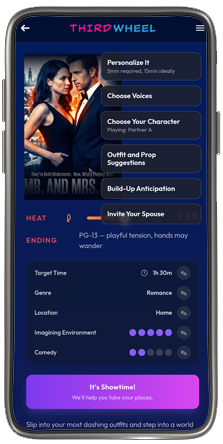



Couple on a couch with a glowing fantasy portal behind them.

For fun or Sizzle

At-home date nights for married couples.

(Formerly Named Third Wheel)
GET the APP
Get it on Google Play Download on the App Store

Research Sources

Figures marked "calculated" are Actalong Lovebirds' own calculations from published results. Unless a study is described as an experiment, it shows a link (association), not proof of cause.

Widespread Desire

1. “Quality 1:1 Time is top desired by parents”

What the research found

Asked what they miss most since having kids, parents' #1 answer was spending quality 1:1 time with their partner (45%), just ahead of going on romantic dates (44%).

Date-night type
Alone (one-on-one time)
Source
Groupon survey conducted by OnePoll, February 2020
Number of people
2,000 U.S. parents of children aged 5–18
Links

2. “81% of parents say they want more date nights”

What the research found

81% of parents said they "need to step things up and have more frequent date nights."

Date-night type
Date nights in general
Source
Groupon survey conducted by OnePoll, February 2020
Number of people
2,000 U.S. parents of children aged 5–18
Links

3. “78% of parents say regular date nights are crucial to keeping the spark”

What the research found

78% of parents said regular date nights are crucial to keeping the spark alive. In the same survey, 79% said they keep date nights short so they can get home to their kids.

Date-night type
Date nights in general
Source
Care.com survey conducted by OnePoll, January 2022
Number of people
2,000 U.S. parents of children aged 5–18
Links

4. “New mothers and fathers had about half as much one-on-one couple time”

What the research found

New mothers and new fathers spent half as much time in one-on-one situations with their partners.

Date-night type
Alone (one-on-one time)
Source
National Marriage Project (University of Virginia), "The Date Night Opportunity," 2012 (Wilcox & Dew), as reported by author Bruce Feiler
Number of people
1,600 married couples (3,200 people)
Links

5. “Married mothers were 2.2× as likely as single non-mothers to feel rushed”

What the research found

The odds of feeling "sometimes or always rushed" were 2.2 times higher for married women with children than for single women without children. Married fathers felt no more rushed than single men without children. Based on U.S. time-diary data from 1998.

Date-night type
Not a date type (time pressure)
Source
Mattingly & Sayer, "Under Pressure," Journal of Marriage and Family, 2006
Number of people
1,672 U.S. adults (708 in 1975, 964 in 1998)
Links

After the Type of Date Nights That Actalong Lovebirds Gives

Type means alone, talking, creative, or acting date nights. Definition varies by study.

6. “Very happy… +22% marriages, +45% sex lives, +39% communication”

What the research found

Wives who had date nights once or twice a month or more, compared with wives who didn't (model-predicted percentages, controlling for age, education, ethnicity, race and household income):

  • Very happy in their marriage: 83% vs 68%
  • Very happy with their sexual relationship: 68% vs 47%
  • Very happy with their communication: 71% vs 51%

+22%, +45% and +39% show how much more likely (calculated: 83÷68, 68÷47, 71÷51). Husbands were similar: 84% vs 70%, 67% vs 47%, 77% vs 59%. This survey captured one point in time, so it shows a link, not proof of cause.

Date-night type
Talking. The survey asked about date nights "where you have a chance to talk, catch up, and do something fun with your spouse."
Source
National Marriage Project (University of Virginia) & Wheatley Institute (Brigham Young University), "The Date Night Opportunity," 2nd edition, 2023; YouGov survey, Fall 2022
Number of people
2,000 married U.S. men and women aged 18–55
Links

7. “More satisfied than 7 in 10 couples on familiar talking dates like eating out”

What the research found

In a 10-week experiment, married couples were randomly assigned to spend 90 minutes a week on either "exciting" activities (e.g., concerts, plays, lectures, skiing, hiking, dancing) or "pleasant," familiar ones (e.g., eating out, a movie, visiting friends, church). The exciting group ended with higher marital satisfaction (adjusted scores 112.61 vs 109.09; effect size .28). "7 in 10" is calculated: the average exciting-date couple scored higher than about 72% of pleasant-date couples.

Date-night type
Creative (new, exciting activities both partners chose)
Source
Reissman, Aron & Bergen, Journal of Social and Personal Relationships, 10(2), 243–254, 1993; details also in Aron et al., Journal of Personality and Social Psychology, 2000
Number of people
53 married couples (106 people)
Links

8. “Couples who laughed together felt closer and more supported”

What the research found

Couples were videotaped telling the story of how they first met. The more of the conversation they spent laughing at the same time, the closer and more supported they felt (a link, not proof of cause). Researchers recorded nearly 1,400 laughs; 62% came from women.

Date-night type
Talking
Source
Kurtz & Algoe, University of North Carolina, Personal Relationships, 2015
Number of people
71 couples (142 people)
Links

9. “Can flood body with same chemicals as first meeting”

What the research found

A leading theory, not directly measured on date nights: new experiences activate the brain's reward system (dopamine and norepinephrine), the same circuits active in early romantic love. Researchers note the brain processes aren't yet fully understood.

Date-night type
Creative (new experiences)
Source
New York Times, "Reinventing Date Night for Long-Married Couples," February 12, 2008, quoting relationship researchers Arthur Aron (Stony Brook University) and Helen Fisher (Rutgers University)
Number of people
Not a single study (theory based on brain-scan research on romantic love)
Links

10. “Laughing triggers endorphin release, increasing bonding”

What the research found

After 30 minutes of watching comedy with close friends, brain scans showed endorphin release. The researchers propose this may be an important pathway supporting social bonds. A separate test found comedy watched in groups raised pain thresholds (a sign of endorphin release) in both men and women.

Date-night type
Shared laughter (friends watching comedy, not couples)
Source
Manninen et al., Journal of Neuroscience, 2017 (University of Turku, Aalto University, University of Oxford)
Number of people
12 men (brain-scan study), plus a separate group of men and women
Links

Mental Benefits

11. “Acting, within 4 weeks, could significantly improve memory, problem-solving and psychological wellbeing”

What the research found

After nine 90-minute theatre sessions over one month, participants improved significantly more than a no-training group on memory, problem-solving and psychological wellbeing, and did better than a visual-arts class on problem-solving. Cognitive gains held four months later. Participants were adults aged 60–86.

Date-night type
Acting
Source
Noice, Noice & Staines, Journal of Aging and Health, 16(4), 562–585, 2004
Number of people
124 adults (44 theatre, 44 visual arts, 36 no training)
Links

One app.
Endless experiences.

Strengthen your bond.

GET the APP
Get it on Google Play Download on the App Store